


Nannying is an unusually personal profession centered on mutual trust. The employer trusts that the nanny will provide their children with quality care according to their agreed-upon expectations, and the nanny trusts that the employer will treat them with fairness and respect. For this reason, some nannies and employers might choose to establish an employment relationship without a contract. But is that ever a good idea? Let’s talk about it.
Is a Written Nanny Contract Legally Required?
The short answer: not always. There are some states and local jurisdictions where you are required to sign a household employment agreement. However, an oral contract (i.e., a verbal agreement) is legally binding in most jurisdictions if certain requirements are satisfied. But without any written evidence of an oral contract, it becomes much more challenging to prove the existence of the agreement or its terms. This can become particularly important if a disagreement lands you in court.
Should You Sign a Contract?
The answer, which may not surprise you, is absolutely. Having worked for a number of families over the years, I can say with certainty that a well-written contract is always an asset to both parties. It serves as the foundation for a healthy, successful employment relationship by providing three key elements: clarity, reference, and protection.
Clarity
Before employment begins, both sides should have clarity regarding the actual terms of the agreement. One obvious way to do this is sitting down and talking it through with one another. But if you ask me, that isn’t enough. A conversation, while helpful, leaves a lot of room for vaguely defined terms. When you put an agreement in writing, you have a better chance of recognizing areas where greater specificity is needed. For example, you might discuss expectations around household tasks, and one such task might be “light cleaning.” In conversation, it might be assumed that both parties have the same definition of light cleaning. But on a document, you might take another look at that phrase and realize it could use clarification. This example may seem like a minor issue, but small differences in interpretation can snowball and create larger disagreements around things like responsibilities and pay. Not a great way to start off a working relationship.
Reference
Many people can attest to the fact that disagreement is a common challenge in working relationships across industries, and the nanny-employer relationship is no exception. Think back to the “light cleaning” example from earlier. Imagine that an employer asks their nanny to take on a few extra housekeeping duties going forward. The nanny isn’t comfortable with this because those tasks weren’t part of what they understood they had agreed to before the job began. How will this conversation go? Realistically, there are plenty of possibilities, but let’s look at two of them.
Scenario 1: They have an oral agreement. Before the position began, they discussed which duties would be included, but they now remember that conversation differently. Because there’s no written record to reference, they can’t come to a consensus on what they initially agreed to. The employer feels that it’s not a big deal and the nanny should be willing to do a few extra chores. The nanny feels that adding more work for no additional compensation would be unfair. What began as a disagreement about a few household tasks creates tension in the employment relationship.
Scenario 2: They have a written contract, which includes a clear list of the nanny’s household duties. They review it together and see that it doesn’t include any of the newly requested tasks. They then have a discussion about whether the nanny is willing to perform the additional tasks and whether the nanny’s pay or other terms should be adjusted. They are able to come to an agreement on the matter and document the change.
Having a written contract with clearly defined responsibilities can make disagreements like this much easier to navigate. Unlike a verbal conversation, a written agreement provides both parties with a shared record of what they decided at the beginning of the employment relationship. If questions arise later, they have something concrete to reference rather than relying solely on memory or differing interpretations.
Protection
This is perhaps the most compelling reason to have a written contract. No one wants to think that something in their employment relationship might go wrong, but unfortunately, it does happen occasionally. If a conflict ends up in court and there’s no clear, written evidence of the agreement terms, both parties are at risk of facing costly legal disputes.
To give a realistic example, let’s consider an employer who arranges a recurring playdate for their child during the nanny’s workday, making the nanny responsible for an additional child. The employer pays the nanny the normal hourly rate for this time, but the nanny remembers that they agreed to adjust the rate for additional children. The employer insists that no such agreement was made. The two go back and forth, attempting to resolve the issue, but they cannot reach an agreement. The nanny then decides to bring the matter to small claims court.
To the disadvantage of both parties, neither of them has any written record of the disputed agreement term. Consequently, the nanny struggles to establish the higher-rate agreement, while the employer has no clear written documentation supporting their understanding of the terms. This highlights the importance of anticipating situations before they occur and proactively addressing them in writing.
The Takeaway
The bottom line is that establishing a written nanny employment agreement before the position begins is always the responsible thing to do. Doing so doesn’t imply distrust for the other party; it shows that both parties are committed to setting clear expectations, which lays the foundation for a thriving employment relationship.
Want to make the hiring process a little easier? Add the Comprehensive Nanny Employment Agreement to your toolkit!
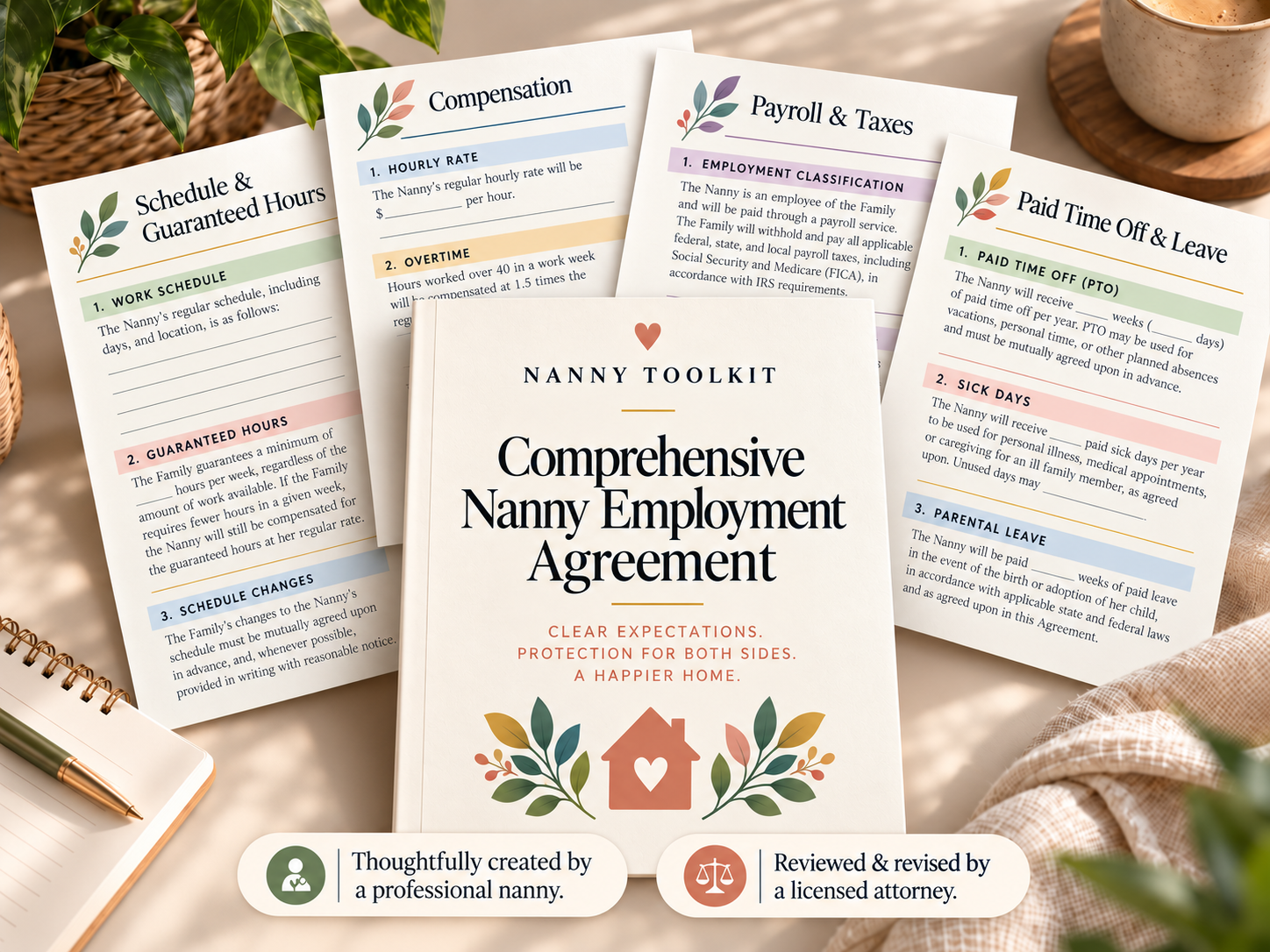
Attorney-Reviewed*
This contract template contains 17 sections. It is fully editable and can be used for standard nanny positions as well as hybrid nanny roles, such as a nanny/family assistants or nanny/household managers. It is NOT designed for use in J-1 au pair employment arrangements.
A free guide on how to properly use this template is also included for your protection and convenience.
56 pages.
Delivered via download link after purchase.
NOTE: Attorney review does not constitute legal advice or guarantee compliance with the laws of your jurisdiction. Templates must be customized to the user's circumstances and applicable law.
