


The decision to hire a nanny is a big one. You’re choosing to trust a new person, often someone you don’t know well, to spend time with your children and become a part of their lives. Even as a nanny myself, I can understand how that might be scary for a parent—especially one who has never hired a private childcare professional before. That’s why I’m here to help.
Although I’ve never been in the position of an employer, I know firsthand what goes into the process: what makes it go smoothly, what makes it more difficult, and what things need to be considered before a contract is signed. If you follow the steps in this guide, you’ll be better equipped to find the right fit for your family.

1. Identify your needs and requirements.
Your needs and requirements define the job scope for potential candidates. By doing so, you proactively narrow down the pool of applicants. While this may initially sound counterintuitive, the purpose is to filter out those who may not be interested in the position or meet your requirements.
Additionally, this helps you figure out what kind of nanny you need. Not all of us are strictly nannies; some are also housekeepers, family/administrative assistants, or household managers. We call people with these kinds of dual-roles hybrid nannies. This is important to note because, as we will discuss later, this will play a part in determining what you will pay your nanny.
To help you determine what kind of nanny you need, read through the job descriptions below, ranging from primarily child-focused positions to broader hybrid household roles. Job titles and responsibilities can vary from household to household, so focus more on the actual duties you need performed than on the title itself.
Nanny
Primarily focuses on providing childcare and completing child-related tasks like maintaining children’s spaces
May transport children to and from school or activities
May do light meal preparation or cooking for the children
Nanny/Housekeeper
Provides both childcare and heavier cleaning and tidying
May mop, vacuum, wash laundry, reset bedding, etc.
Typically does not provide deep or specialized cleaning
Nanny/Family Assistant
Provides childcare, child-related cleaning and tidying, and general administrative support to the employer
Runs errands, manages appointments and schedules, helps the family prepare for events (e.g. birthday party), etc.
May do meal preparation or planning
May do light cleaning and tidying, but typically no heavy housekeeping
Nanny/Household Manager
Combines childcare with assisting the employer directly by overseeing all daily operations of the household
Sets and manages schedules, runs errands, coordinates any services needed in the home (e.g. repairs), etc.
May be responsible for tidying and laundry
May be in charge of other household staff
Often assumes more household-management responsibilities while children are in school or otherwise occupied
It is also worthwhile to identify any additional qualifications you may prefer or require of your nanny. The most common ones that families look for are a driver’s license and clean driving record, a CPR/AED and First Aid certification, a certain number of years of experience, and education or training relevant to childcare.
2. Establish your budget.

This step is fairly straightforward: know what you can afford to pay. There's not much to say here, but there are two considerations I’d like to point out. First, when setting your budget, you should do your best to align it with the scope of the job you identified in the first step. In other words, the amount of pay you offer should reflect the workload, the qualifications you require, and the nanny’s experience level. For example, if you’re seeking someone who will do more than the standard nanny duties, has a college degree, and has at least five years of relevant experience, you can usually expect to pay a little more.
Note: Remember that your total employment budget may also include payroll taxes, paid time off, mileage reimbursement, benefits, and other agreed-upon employment expenses.
A second factor of your budget should be the area where you live. Different cities have different costs of living which inform the local average rate that nannies are paid. While this may have little bearing on how much you would like to pay, it likely will affect your number of qualified applicants.
3. Start your search.
At this point, you should be ready to begin searching for your new nanny! No worries if you’re not sure where to look; I’ve taken care of that part for you. Below you will find a list including some of the most popular platforms where families and nannies connect:

Local or national nanny placement agencies
Local Facebook groups
Local college job boards
Please note that some of these platforms require paid memberships to connect with caregivers. Features and fees may change, so check each platform for its current membership and messaging options.
4. Interview applicants.

On multiple occasions, I’ve encountered first-time nanny employers who admitted that they didn’t really know how to conduct a nanny interview. There’s no shame in that, and I appreciated their transparency. And having been through quite a few interviews myself, I have always been happy to take more responsibility for leading the discussion when needed.
That being said, it’s not just nannies who should prepare for interviews—employers should be ready as well. But what does that even mean? Essentially, it means writing down a list of questions. This might sound obvious to some, but the difficulty some first-time employers encounter is knowing what questions to ask.
Below, I’ve listed some of the most common questions I’ve been asked in past interviews:
How many years of childcare experience do you have?
What ages of children have you cared for?
Are you comfortable caring for multiple children at a time?
Do you have any relevant certifications or training?
Are you able to follow our smoke-free home policy?
Are you comfortable with pets in the home?
Do you have childcare references?
Of course, this list isn’t exhaustive and includes only the most basic questions. Nonetheless, they are a good starting point before asking questions that are more specific to your family and needs.
Tip: Keep interview questions job-related, and be mindful that federal, state, and local employment laws may restrict certain questions about an applicant’s medical history, disability, religion, marital or family status, pregnancy or family plans, and other protected information.
There are also certain interview questions that I feel strongly about, but that I haven’t been asked as often or even at all. Here is another list of questions I wish employers would ask more often:
What is your philosophy on discipline?
How do you approach sibling conflicts?
How do you help a dysregulated child calm down?
Do you prefer to stay indoors or spend time outside the home with the children?
What would you need from me as your employer for you to thrive in this position?
What is your communication style?
How do you view your role as a nanny?
These are harder questions that require a little more reflection to answer, which is precisely why I find them so appealing. They reach deeper than the surface-level questions and address what the employer-nanny relationship might look like, which can be just as important as the nanny-child relationship. Consequently, they do an excellent job of helping both parties determine the compatibility between your family and the prospective nanny.
Finally, you should be sure to leave room in the conversation for the nanny to ask you questions as well. Due to the personal nature of the job, you are essentially being interviewed, too. It is critical that the nanny has a fair chance to gauge whether or not the job is a good fit for them.

5. Conduct background and reference checks.
By this stage, you have likely identified a few candidates you really like. Now it’s time to check on a couple of things. The priority would be running a background check to rule out any recorded history of serious crimes. Platforms like Care.com and UrbanSitter automatically run criminal background checks on caregivers. Nanny placement agencies also typically run these checks on their nannies before allowing them to join. Otherwise, there are many sites like Checkr and BackgroundChecks.com that offer paid background checks.
Additionally, if you collected any references during interviews, you should check those as well. When you contact them, be sure to let them know why you’re reaching out before asking to set up a time to chat. Although it is good practice for nannies to give their references a heads up before they’re contacted, some may inadvertently neglect to do so.
Note: Some nannies prefer to share their references only when a family is genuinely considering making a job offer. This prevents former employers from being contacted repeatedly by multiple prospective families. If a nanny follows this practice, it does not necessarily mean they are unwilling to provide references; they may simply be trying to be respectful of their references' time and privacy.
6. Arrange a trial.

Now that you’ve conducted your interviews, run your checks, and contacted references, it’s time to arrange a trial with your favorite candidate. While not all employers go this route, it is highly recommended. It allows the employer to see how the nanny functions in the role, the nanny to get a feel for the job, and the children to get to know the nanny—all before making any long-term commitments.
Trial periods in which the nanny performs actual work should be paid. Even though the nanny is still being considered for the permanent position, they are still doing real, compensable work. I would also recommend paying the nanny their normal rate for this period. The reasoning is simple: they are not being given reduced responsibilities during the trial, so they should not be paid a reduced rate for performing them.
My final piece of advice on this step would be to have realistic expectations during the trial. Keep in mind that you can’t expect perfection from someone who is just beginning to learn your rules and routines, especially while your children are still warming up to them. Have patience, give grace, and offer guidance when needed. And rather than looking for perfection, pay attention to how the nanny communicates, responds to your children, follows guidance, and adapts as they learn.
7. Negotiate and draft an employment agreement.
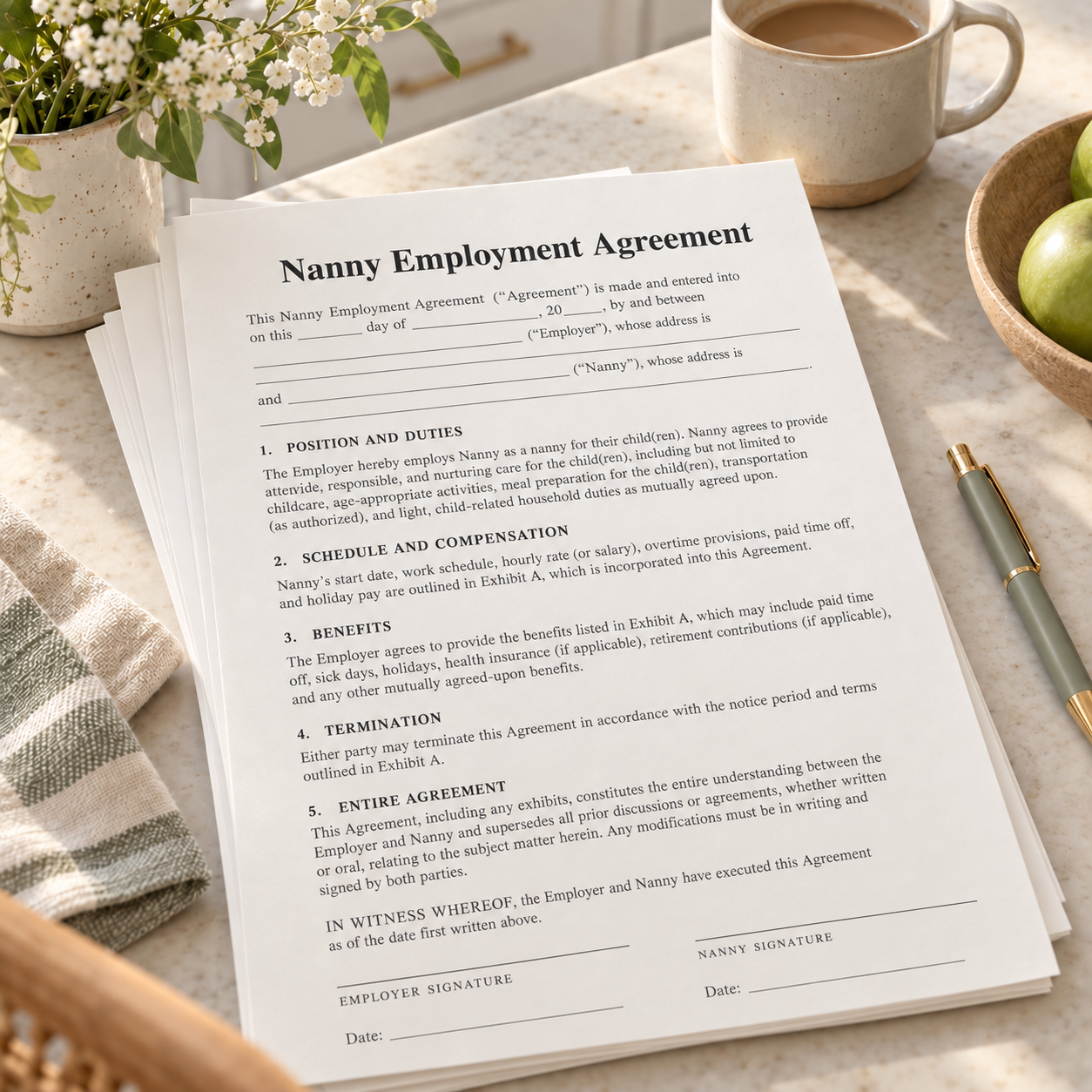
Having a thorough written contract is crucial. It protects both the employer and the nanny by making expectations concrete, reducing misunderstandings, and giving both parties something to refer back to later. Unfortunately, it is one of the more tedious and delicate aspects of the process; tedious because drafting a good employment agreement requires some research, and delicate because some employment terms are subject to federal, state, and local law.
There are a number of topics your agreement should cover, and some others that may not apply to your arrangement. When you anticipate what situations might reasonably come up during the employment term, you don’t have to figure out how to handle them as they arise. This is especially beneficial for uncomfortable scenarios such as termination or severance. Discussing these issues while things are good prevents conflict and escalation later on.
See my list of suggested contract sections below, each categorized as essential, recommended, or as applicable. These categories reflect how broadly applicable I consider each section to be; they are not meant to indicate which provisions are legally required.
Essential: Terms that virtually every nanny employment agreement should address because they define the employment relationship or prevent major misunderstandings.
Recommended: Provisions that are useful for a large percentage of nanny positions but may not apply equally to every family.
As Applicable: Provisions that only need to be included when the particular arrangement involves that issue.
As you are making decisions on what provisions to include, please remember to consult with your nanny. They should be active participants in the process, giving you feedback on your proposed terms and possibly proposing some themselves. Not only does this ensure that both parties are satisfied with the agreement, but it also sets a precedent that both parties’ needs and interests deserve consideration.
Note: Not every employment term is entirely up to the parties to decide. Some are governed by wage-and-hour, tax, sick-leave, workers’ compensation, or other applicable laws. Be sure to check your federal, state, and local laws on household employment.
And one final suggestion on this subject: sign the agreement before the regular position begins, not after. You want both sides to know exactly what they have agreed to in advance.
The Takeaway
Hiring a nanny is a highly involved but generally manageable process. Finding a qualified person is only part of the challenge; finding a good mutual fit for your family is another. Once you’ve done that, you can breathe a sigh of relief and enjoy building a strong working relationship with your new nanny.
Need a comprehensive nanny contract? Let us help:
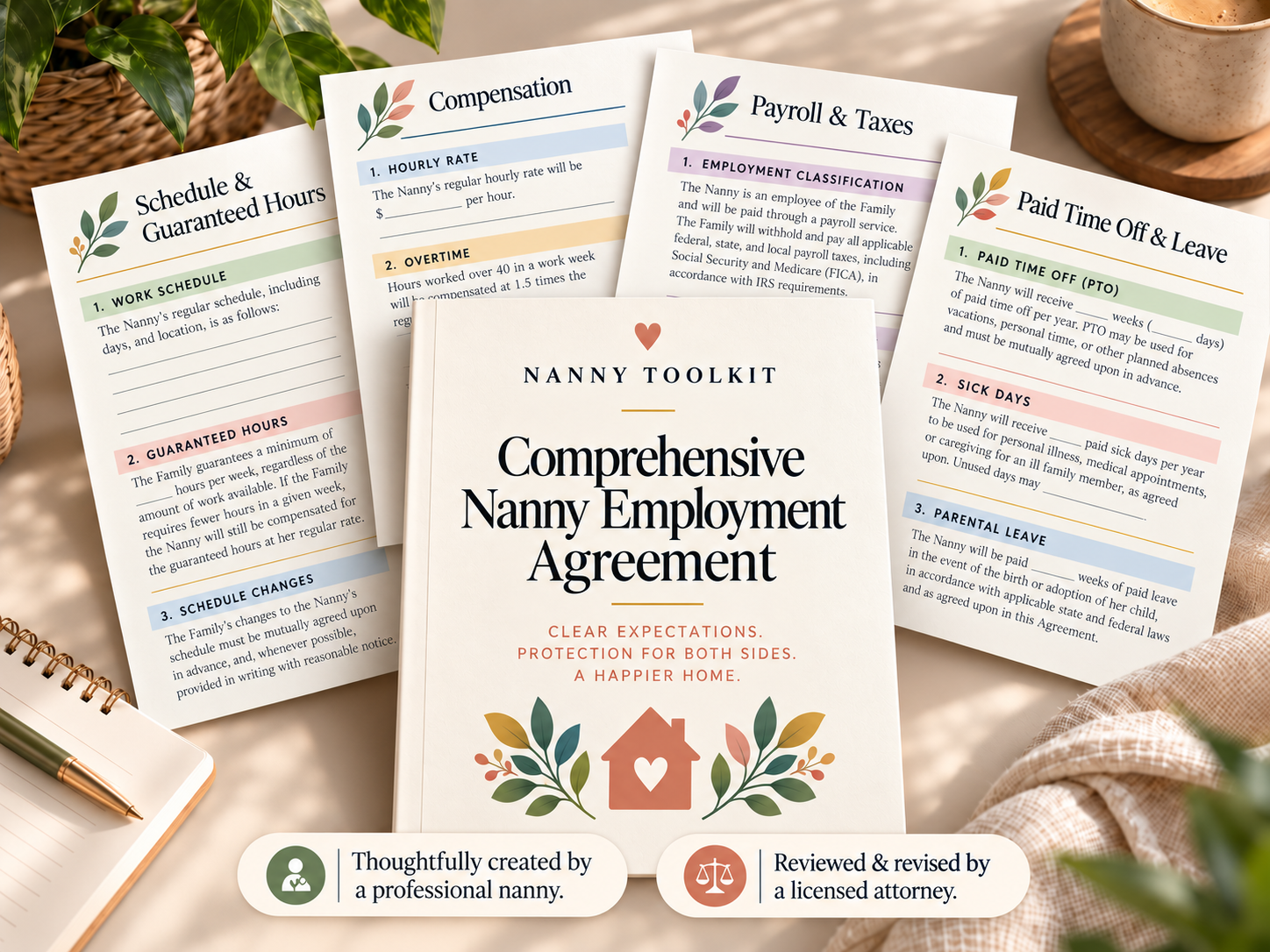
Attorney-Reviewed*
This contract template contains 17 sections. It is fully editable and can be used for standard nanny positions as well as hybrid nanny roles, such as a nanny/family assistants or nanny/household managers. It is NOT designed for use in J-1 au pair employment arrangements.
A free guide on how to properly use this template is also included for your protection and convenience.
56 pages.
Delivered via download link after purchase.
NOTE: Attorney review does not constitute legal advice or guarantee compliance with the laws of your jurisdiction. Templates must be customized to the user's circumstances and applicable law.
